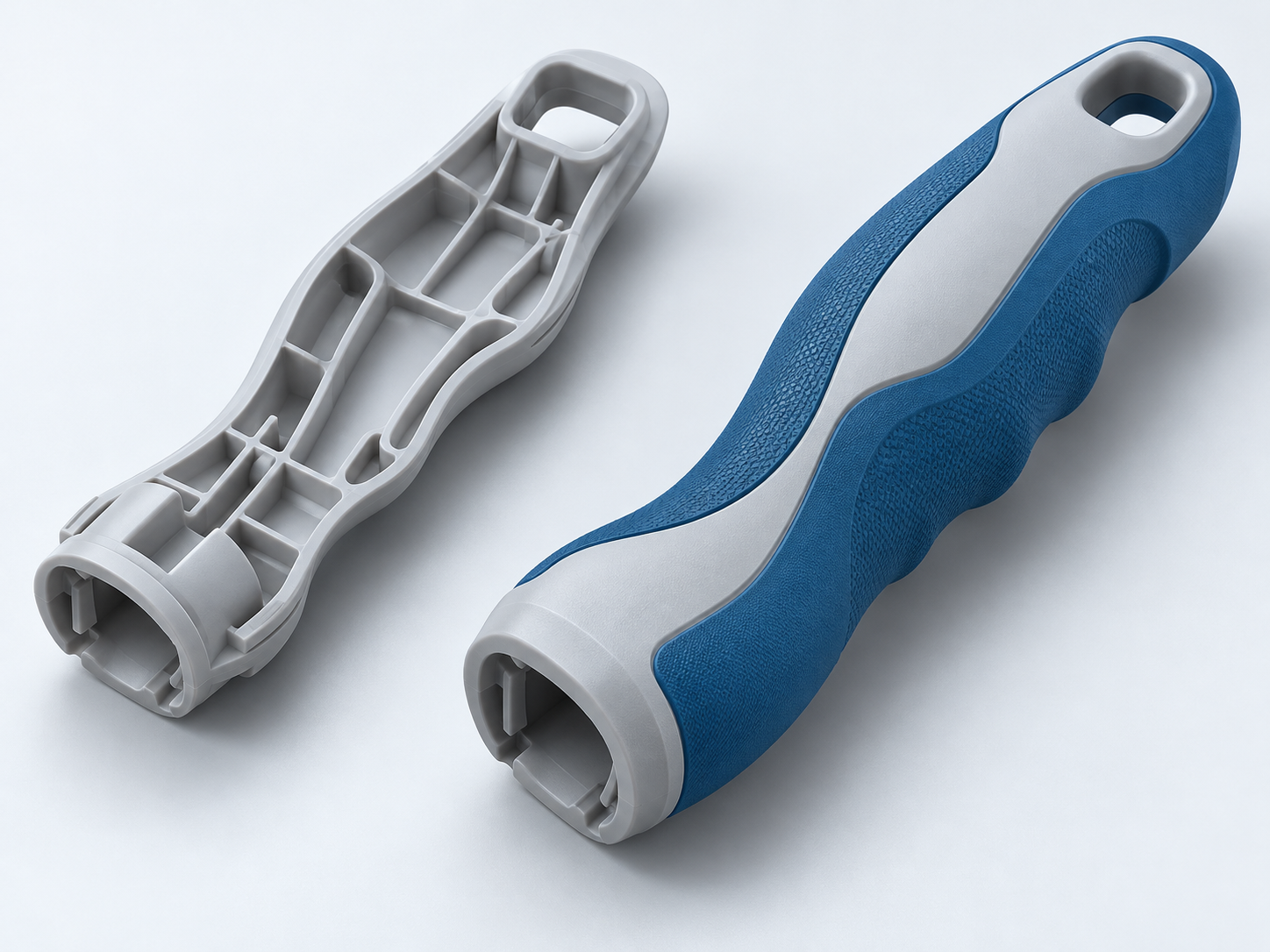
El sobremoldeo agrega otro material sobre áreas seleccionadas de un componente existente. El sustrato proporciona la estructura subyacente, mientras que la capa externa introduce diferentes propiedades en la superficie.
El valor del sobremoldeo proviene de colocar el material adecuado donde cumple un propósito específico.
Agarre & Manejo
Crea áreas de contacto más suaves en mangos, agarraderas, y controles de operación.
Considera la textura de la superficie, la dureza del material, el manejo con humedad o guantes, y el uso repetido. The finished grip should be evaluated in its actual shape and operating conditions.
Surface Protection
Add compliant contact areas where cushioning, wear behavior, or surface protection matters.
Define the contact conditions, including rubbing, local compression, repeated loading, and occasional impact.
Integrated Sealing Features
Incorporate compliant features around defined mating interfaces.
Sealing performance depends on geometry, compresión, material behavior, and operating conditions. Requirements should be evaluated as part of the finished assembly.
Color & Surface Contrast
Combine different colors, textures, or material properties to distinguish functional and visible surfaces.
Identify cosmetic areas, material boundaries, and appearance requirements before tooling.
Seleccione el sustrato y la capa exterior juntos
La selección de materiales comienza con la función del componente terminado, no simplemente con la suavidad de la capa exterior.
Una combinación de materiales adecuada debe cumplir con los requisitos de rendimiento a la vez que sea compatible con el sustrato y el proceso de moldeo propuesto.
TPE
TPE — Elastómeros Termoplásticos
Los compuestos de TPE se consideran comúnmente para empuñaduras suaves, áreas de contacto flexibles, y características conformes.
Consideraciones clave: Grado exacto de material, Dureza, compatibilidad del sustrato, sensación de la superficie, exposición química, y temperatura de servicio.
TPU
TPU — Poliuretano Termoplástico
El TPU es un tipo de TPE que puede seleccionarse donde se requiere resistencia, flexibilidad, o el rendimiento frente a la abrasión es importante.
Consideraciones clave: Propiedades específicas de grado, condiciones de desgaste, exposición química, requisitos de procesamiento, y retención en el sustrato.
LSR puede considerarse cuando la flexibilidad de la silicona y las propiedades relacionadas con la temperatura son relevantes.
Consideraciones clave: Idoneidad del sustrato, condiciones de curado, adhesión o retención mecánica, y el proceso de producción propuesto.
Diseñar la interfaz para resistir la separación
Sección simplificada · característica de retención mecánica
La interfaz entre el sustrato y la capa exterior es una de las características más importantes de un componente sobremoldeado.
Un agarre puede experimentar torsión. Una superficie protectora puede experimentar fricción repetida. Un borde expuesto puede levantarse durante el uso.
La estrategia de retención debe reflejar estas condiciones de carga reales.
Adhesión del material
Combinaciones de materiales adecuadas pueden unirse durante el moldeo.
La adhesión depende de los grados exactos de material, condición de la superficie del sustrato, y condiciones de procesamiento.
Donde la adhesión es crítica, la combinación de materiales y los requisitos de aceptación deben evaluarse durante la aprobación de muestras.
Retención Mecánica
Ranuras, agujeros, rebajes, y las características envolventes pueden ayudar a mantener la capa exterior en posición.
El diseño debe considerar:
Geometría disponible del sustrato
Dirección de las cargas aplicadas
Acceso a herramientas y moldeo
Integridad estructural del sustrato
Levantamiento o rotación potencial de los bordes
Retención Combinada
Algunos componentes utilizan tanto la adhesión del material como características mecánicas.
Este enfoque puede ser apropiado donde la separación podría afectar la función o durabilidad de la pieza terminada.
Prioridad de diseño: Donde la retención es crítica, definir una prueba representativa, dirección de carga, y criterios de aceptación antes de aprobar muestras.
Resolver Detalles Críticos Antes del Moldeo
El éxito del sobremoldeo depende de más que la forma visible del componente terminado.
Los límites de cobertura, flujo de material, posicionamiento del sustrato, y las condiciones de la superficie deben revisarse juntos antes de que se finalice la herramienta.
Concepto de diseño · No a escala
Cobertura & Interfaces funcionales
Definir exactamente dónde comienza y termina la capa externa.
Identificar:
Límites de cobertura del sobremoldeo
Orificios expuestos, roscas, y características de montaje
Superficies de acoplamiento e interfaces críticas
Bordes expuestos a contacto o levantamiento repetido
Superficies cosméticas y límites de material aceptables
La cobertura debe identificarse claramente en el modelo CAD o dibujo.
Concepto de diseño · No a escala
Espesor & Flujo de material
Revisar la capa externa como una geometría completa de moldeo.
Espesor del material, rutas de flujo, rebajes, y transiciones pueden influir en el llenado, contracción, apariencia, y desempeño de la pieza terminada.
Las posiciones de los canales de entrada, ventilación, líneas de separación, y las marcas de moldeo visibles también deben considerarse durante la revisión de las herramientas.
Evite especificar el espesor de la capa únicamente por la suavidad deseada sin considerar el material seleccionado y la geometría del componente.
Concepto de diseño · No a escala
Posición del sustrato & Condición de la superficie
El sustrato debe permanecer correctamente ubicado durante el cierre del molde y la inyección del material.
Proporcione características de ubicación adecuadas, referencias, y requisitos dimensionales.
Limpieza de la superficie, contaminación, recubrimientos, residuos de desmoldeante, y condiciones de almacenamiento pueden afectar la interfaz.
Para sustratos suministrados por el cliente, los requisitos de entrada y las responsabilidades de manipulación deben acordarse antes de la producción.
Elija la Ruta de Producción alrededor del Componente
Sobremolde, moldeo por inserción, y moldeo de dos componentes son conceptos de fabricación relacionados, but they do not always describe mutually exclusive processes.
The appropriate approach depends on the component geometry, material pairing, tooling requirements, and production plan.
Overmolding Onto a Preformed Substrate
An additional material is molded over selected areas of an existing component.
Review priorities:Substrate supply, positioning, material compatibility, coverage, and retention.
Moldeo por inserción
A preformed component, often metal, is positioned inside a mold and incorporated into the molded plastic.
Review priorities:Insert positioning, exposed functional features, loading, and retention.
Two materials are molded through a coordinated production sequence using suitable equipment and tooling.
Review priorities:Material pairing, tooling configuration, processing sequence, and expected production demand.
Which Approach Is Suitable?
The choice should reflect the finished component and total production requirements.
Expected quantity matters, but volume alone does not determine the most suitable process.
Specific manufacturing arrangements are confirmed during project review.
Overmolding for Functional Product Details
Overmolding is useful when different areas of a component require different surface properties.
The following examples show common design directions rather than fixed product configurations.
PROJECT PHOTOGRAPHY
Functional material boundariesApproved product image to be added
Portrait image slot · 3:4
Industrial Handles & Grips
Rigid structural bodies with defined overmolded grip areas.
Revisión:Handling conditions, textura de la superficie, retention, and repeated loading.
Handheld Device Housings
Rigid enclosures with softer contact areas, protective zones, or contrasting surfaces.
Revisión:Housing interfaces, coverage boundaries, visible surfaces, and assembly fit.
Knobs & Operating Controls
Functional controls with differentiated touch surfaces or compliant outer regions.
Revisión:Torque, desgaste, gripping surfaces, and mechanical retention.
Integrated Sealing Features
Overmolded compliant regions designed to contact mating components.
Revisión:Sealing geometry, compresión, material compatibility, and functional testing.
What Affects Your Overmolding Quote?
Overmolding costs should be assessed across the complete manufacturing process—not only the outer material or molding operation.
Substrate Supply
Is the substrate customer-supplied, already available, or included in the new manufacturing scope?
Existing parts may still require dimensional inspection, surface preparation, or positioning evaluation.
Herramientas & Component Complexity
Los límites de cobertura, retention features, exposed interfaces, and substrate support influence tooling requirements.
Changes to the original substrate may also affect the project scope.
Materiales & Appearance
Exact grades, colors, textures, hardness requirements, and cosmetic acceptance criteria can influence material and processing decisions.
Reference samples are helpful where appearance or surface feel is important.
Muestreo & Production Demand
Initial samples, design revisions, functional evaluations, and inspection requirements should be considered alongside tooling and production costs.
Provide your initial order quantity and expected repeat demand so the manufacturing scope can be assessed accordingly.
Project note:Quotation requirements and timing depend on the drawings, materiales, cantidades, and technical information available for review.
Validate the Finished Component
An overmolded part should be evaluated as a combination of materials, geometry, and function.
Appearance approval alone may not establish acceptable retention, assembly fit, or sealing performance.
Dimensions & Assembly Fit
Verify critical features, posicionamiento del sustrato, mating dimensions, and the required assembly interfaces.
Cobertura & Appearance
Review material boundaries, exposed features, textura de la superficie, color, flash, and visible defects against agreed requirements.
Adhesion & Retention
Where separation affects function, assess retention under representative loading conditions.
Tests may consider pulling, twisting, or edge lifting, depending on the component design.
Functional Performance
Evaluate applicable grip, desgaste, protective, or sealing requirements under defined conditions.
Repeatability & Documentación
Record approved samples, material specifications, inspection requirements, and acceptance criteria to support repeat production. Before release, see how toreview and approve molded samples.
The project review should establish which evaluations are included in the supply scope and which are performed by the customer or a designated testing provider.
Frequently Asked Questions
Can an existing plastic part be overmolded?
An existing part may be suitable, depending on its material, geometry, surface condition, and ability to be positioned during molding.
Provide the substrate drawing, exact material grade, and information about coatings or surface treatments. A physical sample may also help with evaluation.
How do I specify the required softness or grip?
Start with the intended handling conditions, required surface texture, and any known material hardness specification.
Reference products or physical samples can help communicate the desired feel. The final component should be evaluated in its intended use.
Will the outer layer peel away?
Separation is a potential failure mode that should be addressed through material selection, retention geometry, surface control, y condiciones de procesamiento.
Donde la retención es crítica, agree on representative test conditions and acceptance criteria before production approval.
Can silicone be used for overmolding?
Silicone may be suitable for certain applications. The substrate, silicone grade, condiciones de curado, and bonding or mechanical retention strategy must be reviewed together.
The production route should be confirmed for the specific component.
Can I supply the rigid substrates?
Sí, customer-supplied substrates can be considered during project review.
Proveer el dibujo, material grade, surface requirements, and available quantities. Incoming inspection, packaging, handling, and supply responsibilities should be agreed before production.
Does overmolding eliminate assembly operations?
It may integrate grips, almohadillas, or compliant features that would otherwise be installed separately.
Other finishing, inspection, and assembly operations may still be required. The benefit should be evaluated across the complete production process.
Discuss Your Overmolding Project
Share your drawings and describe what the outer layer needs to achieve.
Whether your material combination is already specified or still under evaluation, clear project information helps establish a practical manufacturing scope.
If material selection or design details are still open, identify them in your inquiry. Reference samples or photographs may also be useful.