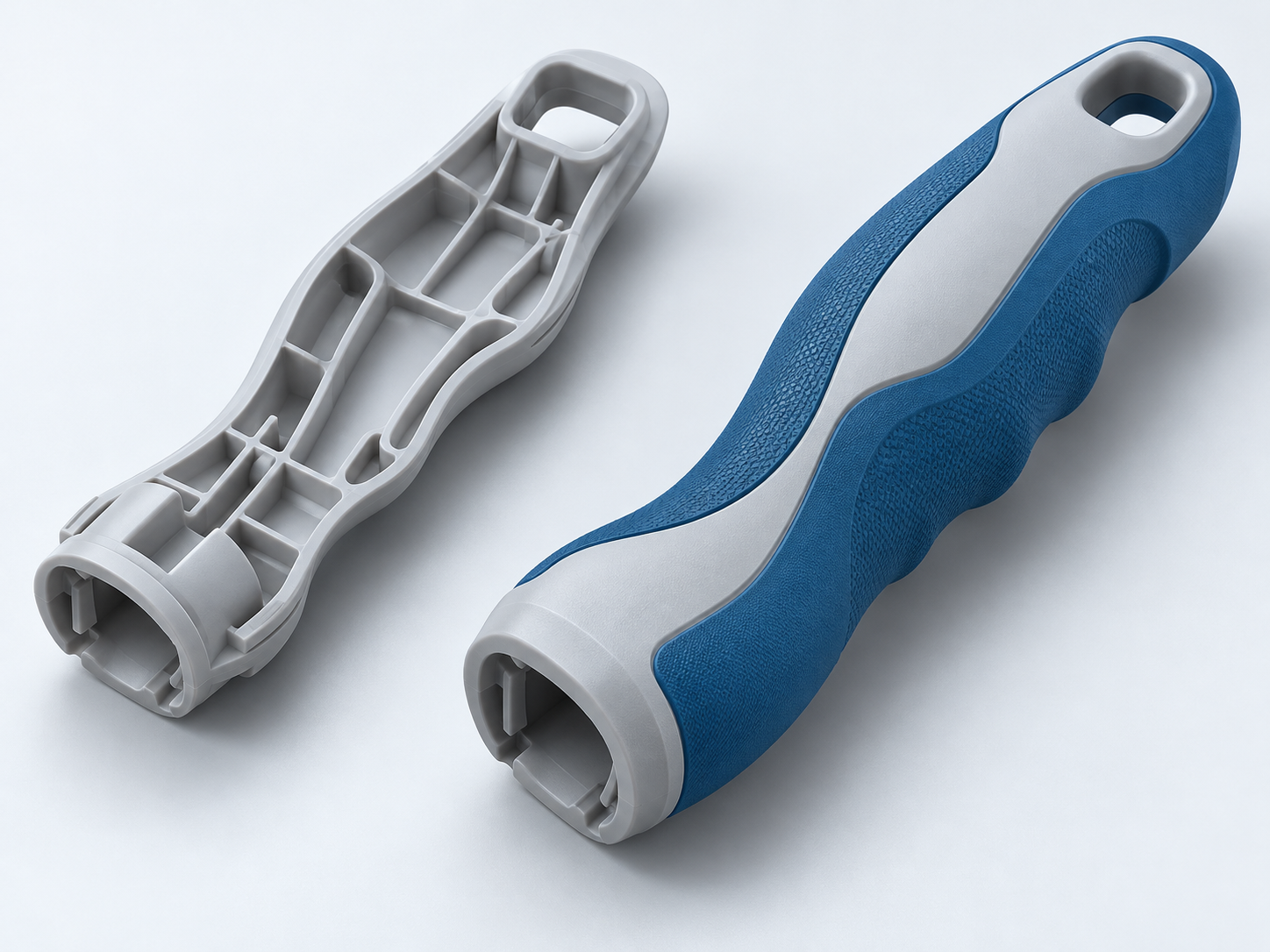
Overmolding adds another material over selected areas of an existing component. The substrate provides the underlying structure, while the outer layer introduces different properties at the surface.
The value of overmolding comes from placing the right material where it serves a specific purpose.
Grip & Handling
Create softer contact areas on handles, grips, and operating controls.
Consider surface texture, material hardness, wet or gloved handling, and repeated use. The finished grip should be evaluated in its actual shape and operating conditions.
Surface Protection
Add compliant contact areas where cushioning, wear behavior, or surface protection matters.
Define the contact conditions, including rubbing, local compression, repeated loading, and occasional impact.
Integrated Sealing Features
Incorporate compliant features around defined mating interfaces.
Sealing performance depends on geometry, compression, поведение материала, and operating conditions. Requirements should be evaluated as part of the finished assembly.
Color & Surface Contrast
Combine different colors, textures, or material properties to distinguish functional and visible surfaces.
Identify cosmetic areas, material boundaries, and appearance requirements before tooling.
Select the Substrate and Outer Layer Together
Material selection starts with the function of the finished component—not simply the softness of the outer layer.
A suitable material combination must meet performance requirements while remaining compatible with the substrate and proposed molding process.
TPE
TPE — Thermoplastic Elastomers
TPE compounds are commonly considered for soft grips, flexible contact areas, and compliant features.
Key considerations:Exact material grade, твердость, substrate compatibility, surface feel, chemical exposure, and service temperature.
TPU
TPU — Thermoplastic Polyurethane
TPU is a type of TPE that may be selected where toughness, flexibility, or abrasion performance is important.
Key considerations:Grade-specific properties, wear conditions, chemical exposure, processing requirements, and retention on the substrate.
LSR
LSR — Liquid Silicone Rubber
LSR may be considered where silicone flexibility and temperature-related properties are relevant.
Key considerations:Substrate suitability, curing conditions, bonding or mechanical retention, and the proposed production process.
Design the Interface to Resist Separation
Simplified section · Mechanical retention feature
The interface between the substrate and outer layer is one of the most important features of an overmolded component.
A grip may experience twisting. A protective surface may experience repeated friction. An exposed edge may be lifted during use.
The retention strategy should reflect these actual loading conditions.
Material Adhesion
Suitable material combinations may bond during molding.
Adhesion depends on the exact material grades, substrate surface condition, and processing conditions.
Where adhesion is critical, the material combination and acceptance requirements should be evaluated during sample approval.
Mechanical Retention
Grooves, отверстия, undercuts, and wraparound features can help hold the outer layer in position.
The design should consider:
Available substrate geometry
Direction of applied loads
Tooling and molding access
Structural integrity of the substrate
Potential edge lifting or rotation
Combined Retention
Some components use both material adhesion and mechanical features.
This approach may be appropriate where separation could affect the function or durability of the finished part.
Design priority:Where retention is critical, define a representative test, loading direction, and acceptance criteria before approving samples.
Resolve Critical Details Before Tooling
Successful overmolding depends on more than the visible shape of the finished component.
Coverage boundaries, material flow, substrate positioning, and surface conditions should be reviewed together before tooling is finalized.
Design concept · Not to scale
Coverage & Functional Interfaces
Define exactly where the outer layer begins and ends.
Identify:
Overmold coverage boundaries
Exposed holes, резьбы, and mounting features
Mating surfaces and critical interfaces
Edges exposed to repeated contact or lifting
Cosmetic surfaces and acceptable material boundaries
Coverage should be clearly identified in the CAD model or drawing.
Design concept · Not to scale
Thickness & Material Flow
Review the outer layer as a complete molding geometry.
Material thickness, flow paths, recesses, and transitions can influence filling, shrinkage, внешний вид, and finished-part performance.
Gate positions, venting, parting lines, and visible molding marks should also be considered during tooling review.
Avoid specifying layer thickness solely by the desired softness without considering the selected material and component geometry.
Design concept · Not to scale
Substrate Position & Surface Condition
The substrate must remain correctly located during mold closure and material injection.
Provide suitable locating features, datums, and dimensional requirements.
Surface cleanliness, contamination, coatings, mold-release residues, and storage conditions may affect the interface.
For customer-supplied substrates, incoming requirements and handling responsibilities should be agreed before production.
Choose the Production Route Around the Component
Доливка (овермолдинг), insert molding, and two-shot molding are related manufacturing concepts, but they do not always describe mutually exclusive processes.
The appropriate approach depends on the component geometry, material pairing, tooling requirements, and production plan.
Overmolding Onto a Preformed Substrate
An additional material is molded over selected areas of an existing component.
Review priorities:Substrate supply, positioning, material compatibility, coverage, and retention.
Литьё с вставкой
A preformed component, often metal, is positioned inside a mold and incorporated into the molded plastic.
Review priorities:Insert positioning, exposed functional features, loading, and retention.
Two materials are molded through a coordinated production sequence using suitable equipment and tooling.
Review priorities:Material pairing, tooling configuration, processing sequence, and expected production demand.
Which Approach Is Suitable?
The choice should reflect the finished component and total production requirements.
Expected quantity matters, but volume alone does not determine the most suitable process.
Specific manufacturing arrangements are confirmed during project review.
Overmolding for Functional Product Details
Overmolding is useful when different areas of a component require different surface properties.
The following examples show common design directions rather than fixed product configurations.
PROJECT PHOTOGRAPHY
Functional material boundariesApproved product image to be added
Portrait image slot · 3:4
Industrial Handles & Grips
Rigid structural bodies with defined overmolded grip areas.
Review:Handling conditions, surface texture, retention, and repeated loading.
Handheld Device Housings
Rigid enclosures with softer contact areas, protective zones, or contrasting surfaces.
Review:Housing interfaces, coverage boundaries, visible surfaces, and assembly fit.
Knobs & Operating Controls
Functional controls with differentiated touch surfaces or compliant outer regions.
Review:Torque, износ, gripping surfaces, and mechanical retention.
Integrated Sealing Features
Overmolded compliant regions designed to contact mating components.
Review:Sealing geometry, compression, material compatibility, and functional testing.
What Affects Your Overmolding Quote?
Overmolding costs should be assessed across the complete manufacturing process—not only the outer material or molding operation.
Substrate Supply
Is the substrate customer-supplied, already available, or included in the new manufacturing scope?
Existing parts may still require dimensional inspection, surface preparation, or positioning evaluation.
Tooling & Component Complexity
Coverage boundaries, retention features, exposed interfaces, and substrate support influence tooling requirements.
Changes to the original substrate may also affect the project scope.
Материалы & Appearance
Exact grades, colors, textures, hardness requirements, and cosmetic acceptance criteria can influence material and processing decisions.
Reference samples are helpful where appearance or surface feel is important.
Sampling & Production Demand
Initial samples, design revisions, functional evaluations, and inspection requirements should be considered alongside tooling and production costs.
Provide your initial order quantity and expected repeat demand so the manufacturing scope can be assessed accordingly.
Project note:Quotation requirements and timing depend on the drawings, материалы, quantities, and technical information available for review.
Validate the Finished Component
An overmolded part should be evaluated as a combination of materials, geometry, and function.
Appearance approval alone may not establish acceptable retention, assembly fit, or sealing performance.
Размеры & Assembly Fit
Verify critical features, substrate positioning, mating dimensions, and the required assembly interfaces.
Coverage & Appearance
Review material boundaries, exposed features, surface texture, цвет, flash, and visible defects against agreed requirements.
Adhesion & Retention
Where separation affects function, assess retention under representative loading conditions.
Tests may consider pulling, twisting, or edge lifting, depending on the component design.
Functional Performance
Evaluate applicable grip, износ, protective, or sealing requirements under defined conditions.
Repeatability & Documentation
Record approved samples, material specifications, inspection requirements, and acceptance criteria to support repeat production.
The project review should establish which evaluations are included in the supply scope and which are performed by the customer or a designated testing provider.
Часто задаваемые вопросы
Can an existing plastic part be overmolded?
An existing part may be suitable, depending on its material, geometry, surface condition, and ability to be positioned during molding.
Provide the substrate drawing, exact material grade, and information about coatings or surface treatments. A physical sample may also help with evaluation.
How do I specify the required softness or grip?
Start with the intended handling conditions, required surface texture, and any known material hardness specification.
Reference products or physical samples can help communicate the desired feel. The final component should be evaluated in its intended use.
Will the outer layer peel away?
Separation is a potential failure mode that should be addressed through material selection, retention geometry, surface control, and processing conditions.
Where retention is critical, agree on representative test conditions and acceptance criteria before production approval.
Can silicone be used for overmolding?
Silicone may be suitable for certain applications. The substrate, silicone grade, curing conditions, and bonding or mechanical retention strategy must be reviewed together.
The production route should be confirmed for the specific component.
Can I supply the rigid substrates?
Да, customer-supplied substrates can be considered during project review.
Provide the drawing, material grade, требования к поверхности, and available quantities. Incoming inspection, packaging, handling, and supply responsibilities should be agreed before production.
Does overmolding eliminate assembly operations?
It may integrate grips, pads, or compliant features that would otherwise be installed separately.
Other finishing, инспекция, and assembly operations may still be required. The benefit should be evaluated across the complete production process.
Discuss Your Overmolding Project
Share your drawings and describe what the outer layer needs to achieve.
Whether your material combination is already specified or still under evaluation, clear project information helps establish a practical manufacturing scope.
If material selection or design details are still open, identify them in your inquiry. Reference samples or photographs may also be useful.