
Thin-Ring Inspection Example
Precision CNC Turned Aluminum Parts
Precision aluminum rings, sleeves and turned parts with careful control of workholding distortion and functional fits.
- Process
- Review turning and workholding for the wall section
- Materials
- Confirm aluminum alloy and temper
- Quantity
- State initial and repeat quantities
- Inspection
- Specify bore size, form and free-state condition
Product Overview
GPT Precision manufactures custom aluminum turned parts according to customer drawings, including rings, sleeves, bushings and other rotational components.
Thin-walled components may require special attention to clamping, tool forces and dimensional changes after release.
Key Features
- Consider a turned aluminum ring with a close-fit bore and an axial seating face.
- During machining, chuck pressure may deform the ring wall.
- The bore can appear round while the component is clamped but change shape when the gripping force is removed.
- The final acceptance condition must therefore be considered during workholding planning.
Manufacturing Considerations
- Where accessible, machining the bore and seating face in one setup may help preserve their relationship.
- Suitable jaw contact or alternative workholding can reduce concentrated gripping loads while providing adequate support for machining.
- The arrangement must remain stable under cutting forces.
Quality Control & Inspection
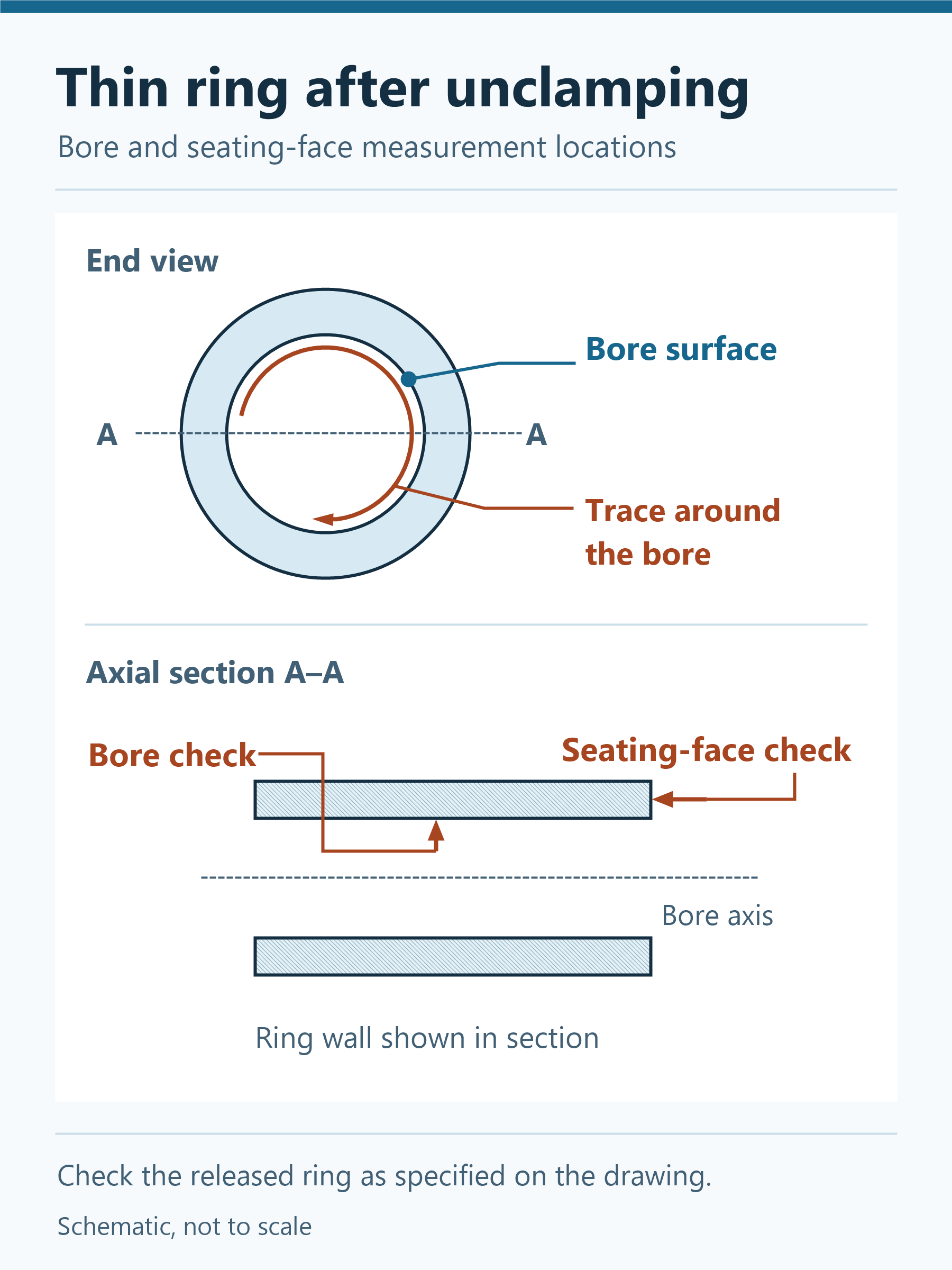
- For dimensions specified in the free state, support the released component without reshaping it.
- Measure the bore size and any specified form characteristics using appropriate methods.
- A two-point diameter measurement may not detect certain lobed profiles, so a more complete circumference-based method may be required for roundness evaluation.
- Where specified, seating-face orientation is evaluated relative to the designated datum axis.
Specifications to Confirm
| Bore and seating face | Confirm bore size, any roundness control and the seating-face relationship to the bore axis. |
|---|---|
| Free-state support | Define how the released ring is supported during inspection. |
Assembly Considerations
Radial fit
Identify the mating diameter and required bore fit.
Axial seating
Identify the face that seats against the mating shoulder.
Related Products

Request an Aluminum Turning Quote
Provide your drawing, material grade, quantity and any critical bore, roundness, seating-face or free-state inspection requirements.